Queer HCI in India
Understanding Indian queer youth's expectations and aspirations regarding social media
HCI Research - Critical HCI
Project Overview
Findings
The following section details some themes that emerged. They describe the lived experiences of queer youth from urban India and the ways in which social media shapes their lives.
4.1 Privacy and Safety
Privacy was a leading concern for the participants. Most participants were not out to their families or peers and feared being outed through social media. P6 said:
”As I am not out to everyone, I do not post things that are related to the community. I am still picking out people who are safe to come out to and only telling them and not others because I am scared of being physically or emotionally hurt.”
Most participants felt that most sites asked for a lot of data from the users and they shouldn’t. Some even felt that asking for emails for sign ups was also too much. Data taken by dating applications was a big concern. Given that they recorded location and showed their profile to people in their vicinity, made half the participants were very concerned about their physical safety. P4 recounts:
”When people around my house found out that I am gay, some threatened to call the cops on me.”
To counter this P6 used Reddit to find a partner because of the anonymity it provided. They said:
”It felt like I couldn’t find a platform to look for people to date without putting myself out there. Since I hadn’t yet come out, I couldn’t get on main dating sites and thus turned to Reddit.”
The participants also felt that their Privacy needs could be addressed by providing higher customisation for visibility controls. If they could choose who to show certain posts to, who to reveal pronouns to, etc., they would feel safer in expressing themselves online. P7 expects:
”There should be a way to balance online visibility and still be able to access other features.”
4.2 Self Discovery and Expression
Social media sites played an important role in the participants journeys of understanding their self better and unlearning. Most participants reported that they had an inkling that they were queer from a young age, but they didn’t have the vocabulary to understand it or express it. It was through social media that they got introduced to terms that allowed them to express it. Most noted how unlearning and learning was a process and they were still figuring it out. P5 notes:
”Recently, I have been feeling more fluid about my gender identity. While I am still a homosexual person, I think I am not a cis man anymore. I feel connected to the term ’enby’ now.”
Some participants noted how private Instagram profiles allowed them to express freely. P4 said:
”I am sometimes more authentic on social media.”
Most participants would adapt features to suit their self expression like mentioning their pro- nouns or putting the pride flag in their bio on platforms like Twitter and Instagram. Because of the limited gender options on dating apps like Tinder, Hinge and Bumble participants would again specify their gender identity and sexuality in their bio, but their experience would be bad on these applications because when it came to people they’d want to match with they only had binary options or a faulty non-binary option. The participants discussed that self identification of diverse gender identities is a basic feature that all apps should provide. P6 said:
”Why do they have to give options? Just give us a blank or at least give us the option to self describe if they want to provide options.”
All participants want that social media sites become more inclusive and that they are able to express or not express without feeling pressurised to. P7 said:
”The adding your pronouns thing has led me to feel pressured into adding my pronouns. Since I use she/her it makes me feel disconnected from the queer community.”
4.3 Community, Awareness and Solidarity
One of the most common positive experience discussed was finding communities online where the participant felt some sense of belonging. P4 said:
”I am delighted to report that I became a part of a queer Christian theology group on social media.”
Social media was also integral to their experience of the pandemic. Being part of online communities provided an escape from abusive households and hope for an understanding chosen family. It was quite essential as P4 mentions:
”A lot of people lost their livelihood or were facing a lot of abuse during the pandemic. Social media really helped to spread the word about fundraisers to help support them.”
Participants who were a part of queer collectives talked about how important social media was for bringing together people for support when things went wrong. They also talked about how integral social media was for the awareness campaigns carried out by the collectives. In this case social media becomes important as a tool for building solidarity and spreading awareness. All participants envision social media to be a space that can help accelerate social change. Thinking of ways this takes place through social media, P3 says:
”I think social media should give so many options for gender identity that the gender binary doesn’t stay relevant as the default.”
All participants were concerned about the accessibility of online communities and information. They discussed how most communities and information are inaccessible because of language barriers. A solution to pointed out by P2 is:
”These sites should improve their translation features. Most websites can’t translate to regional languages.”
Participants also discussed how there should be regional social media so that communities can form offline alongside the digital world.
Reflections
5.1 Queer Representation in STEM
During the discussions, a lot of the participants mentioned how they felt that the issues with social media could be traced to the lack of queer folx working in STEM fields. They felt that some issues were so obvious and perhaps easy to address that any participation from the queer community would have ensured that they didn’t exist. This brings us back to our initial discussion of lack of literature focusing on the experiences of queer individuals. This also makes us reflect on the standards and practices of the tech industry, with very few initiatives focused on including and inducting more queer people into the field. This can also be traced to the problem that Indian technical institutes don’t offer safe and conducive environments for queer individuals.
5.2 Towards Co-designing
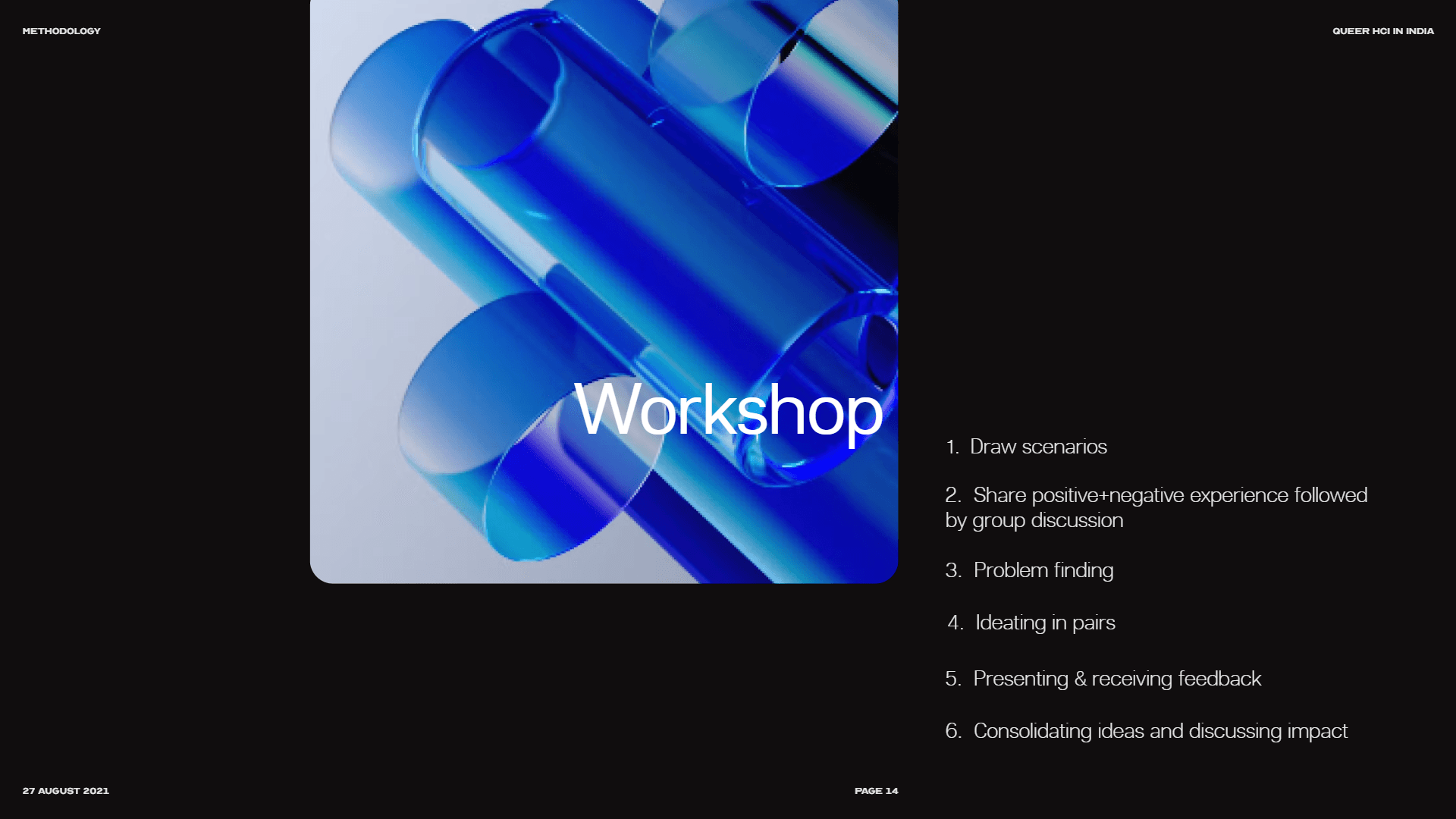
While the workshop led to intriguing discussions and good ideas, it was difficult for the participants without a technical background to think of different features or design decisions. An explicit gap we noticed was the lack of discussion on how social media algorithms impact their experience. Hence, this did not come up during ideation either. This makes us reflect on the design of the workshop and the need for co-designing by involving various stakeholders - users, designers, programmers, policy makers, etc.